Scottsdale Luxury Real Estate
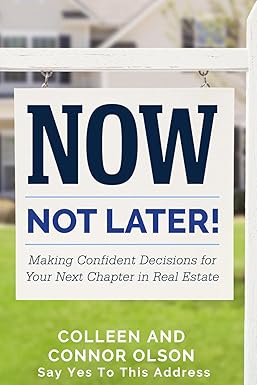
Now, Not Later!
Making Confident Decisions for Your Next Chapter in Real Estate
License SA550841000 · Scottsdale, Arizona
Making Confident Decisions for Your Next Chapter in Real Estate
License SA550841000 · Scottsdale, Arizona
Buying a home is not just about finding a property. It is about trust, timing, and choices that ripple through your financial and emotional life for years to come. The right decision creates stability, wealth, and memories. The wrong step can quietly cost tens of thousands and leave you carrying regret.
That is why Colleen and Connor Olson wrote Now, Not Later! - two guides in one volume, each crafted for a different situation you might find yourself in right now.
Book One is for homeowners ready to make their next move - those who have built equity and are considering how to leverage their position for their next chapter.
Book Two speaks directly to renters who are ready to break free from the cycle of building someone else's wealth and start building their own.
You have been given more than a book. You have been given a partner who will not let you stumble into the traps that so many buyers fall into.
Your home should serve your life, not consume it. Yet many homeowners find themselves spending their prime years managing properties that no longer match how they actually live. Empty bedrooms become storage. Formal rooms become mail stations. Yards become obligations.
The cost differential between maintaining 5,000 versus 2,000 square feet can reach $50,000 to $120,000 over ten years - not counting the hidden cognitive load of fragmented time and energy spent across property management tasks.
The goal is not to judge previous choices. It is to align your current reality with your living environment - so your home becomes a platform for the life you want, not a barrier to it.
When homeowners tell us they are waiting for rates to drop, we understand the impulse. But for established homeowners with substantial equity, the traditional affordability equation has changed entirely. A homeowner with $450,000 in equity purchasing a $500,000 home only borrows $50,000 - creating a $300 monthly payment at six percent. Compare this to a first-time buyer financing $400,000 at $2,398 monthly.
The most important calculation is not the percentage - it is the equation between the life you are living and the life you want. Two years of waiting for better market conditions, when carrying costs run $20,000–$40,000 annually, means you need rates to drop enough to save more than what you are spending to stand still.
Where you live shapes who you see and how engaged you remain with the world. Distance grows heavier with time - what feels reasonable in your sixties becomes prohibitive in your seventies. A twenty-minute drive to visit grandchildren becomes forty minutes round-trip plus preparation, until spontaneous becomes planned and easy becomes effortful.
Research consistently demonstrates that social isolation accelerates cognitive decline, increases depression risk, and contributes to earlier mortality. The years spent living at a distance from your priorities are years of connection you cannot recover. Moving closer while you still have the energy and capability to build new community ties proves far more successful than waiting until proximity becomes a necessity.
There are two clocks governing your housing decisions: the market clock and your life clock. The pursuit of optimal market timing often becomes a sophisticated form of procrastination. Professional economists, Federal Reserve officials, and market analysts - armed with sophisticated models - regularly miss the mark on rate movements and price trends.
Meanwhile, grandchildren do not postpone growing up because you are waiting for better market conditions. Your energy level does not pause its natural decline while you analyze rate forecasts. Health changes do not align themselves around optimal real estate timing. The goal is not perfect timing - it is purposeful timing that aligns your housing situation with your life priorities while you still have the capability and energy to create the changes you want.
A home is the stage where your life unfolds - the environment that either amplifies or constrains your daily experiences. Every life contains multiple chapters, each requiring different settings. The trap many homeowners encounter is attempting to write their current chapter in a setting designed for a previous one.
The equity you have built over decades represents more than numbers on financial statements - it is stored potential, accumulated freedom that can be deployed strategically to purchase proximity to grandchildren, freedom from yard work responsibilities, peace of mind from simplified living, or financial flexibility for experiences you have deferred. Your next chapter is waiting to be written. The only question is whether you will write it in a setting that serves the story you want to tell.
When you rent, every dollar belongs to someone else. Month after month, you are building equity - for your landlord, not for yourself. Your rent covers their mortgage principal, pays down their loan balance, and increases their net worth. Meanwhile, you receive thirty days of housing, then the cycle starts over.
Unlike mortgage payments, rent never stays fixed. Annual increases slowly push your costs higher while you build no equity to offset rising expenses. Every year you delay ownership is a year you cannot reclaim. The rent trap is powerful because it masquerades as financial caution - convincing you that you are being responsible while quietly preventing you from building wealth.
The belief that perfect market conditions will align to create an ideal buying opportunity is one of the most seductive and expensive myths in real estate. Real estate markets are influenced by dozens of variables that never align perfectly. The perfect timing myth creates moving goalposts - when rates drop, you worry about prices; when prices soften, you fear rate increases.
The most successful real estate investors understand a fundamental truth: time in the market beats timing the market. Wealth is built through ownership duration, not purchase timing. The right time to buy is not determined by market conditions - it is determined by personal readiness.
Inflation attacks renters from multiple directions: home prices rise, rents increase, construction costs climb, and the purchasing power of your savings erodes. Every month spent accumulating "just a little more" often results in needing significantly more. If home prices inflate at 6% annually and you can save an extra $1,000 per month, you need to be shopping for homes under $200,000 just to break even.
Fixed-rate mortgages are powerful tools against inflation because they lock in your largest expense at today's dollars while the asset typically appreciates. The only way to escape the inflation squeeze is to transition from variable housing costs to fixed housing costs as quickly as possible.
Extended renting creates hidden costs that no financial calculator captures: the limitation of life experiences, the postponement of dreams, and the psychological weight of temporary living that stretches into years. Renting creates a temporary mindset that affects every aspect of daily life - you live in spaces you cannot truly make your own, avoid quality items because you "might move soon," and postpone getting pets due to restrictions.
When Colleen and Connor help clients transition from renting to owning, they see it represents more than a change in housing status - it is permission to live fully in the present rather than perpetually preparing for an uncertain future. Every month you spend in temporary housing is a month you are not fully living in a permanent space.
The transition to homeownership begins in your mind, not in your bank account. The clients who successfully make the leap share certain mental shifts: from perfect conditions to good enough conditions, from a renting mentality to an equity-building focus, and from flexibility fears to stability benefits.
Colleen and Connor have developed a structured timeline that moves clients from decision to closing efficiently - covering financial readiness assessment, team assembly, active searching, and first-year ownership strategies. The difference between clients who successfully transition to ownership and those who remain stuck in rental cycles is not financial capacity or market timing. It is the decision to act despite uncertainty.

Call or text Colleen directly. She responds personally and will give you an honest assessment of your situation - no pressure, no scripts.
If you have built equity and are wondering whether now is the time to make your next move - Colleen can walk you through the real numbers, no obligation.
Not sure if you are ready to buy? Colleen can assess your financial position honestly and help you understand exactly what is possible - and what it is costing you to wait.
Order Now, Not Later! on Amazon and start making decisions with clarity and confidence before your first conversation.
Buy on AmazonTwo complete guides in one volume - for homeowners ready to make their next move and renters ready to break free. By Colleen & Connor Olson, published by By Referral Only.